
Your Competitor Didn't Win Because They Worked Harder
Hard work alone doesn't win competitive deals in the IT industry. Businesses succeed by understanding customer challenges, asking better questions, and delivering meaningful value. Discover why customer-first strategies consistently outperform effort alone and learn how to build stronger, trust-driven business relationships.
 اويفا
اويفا 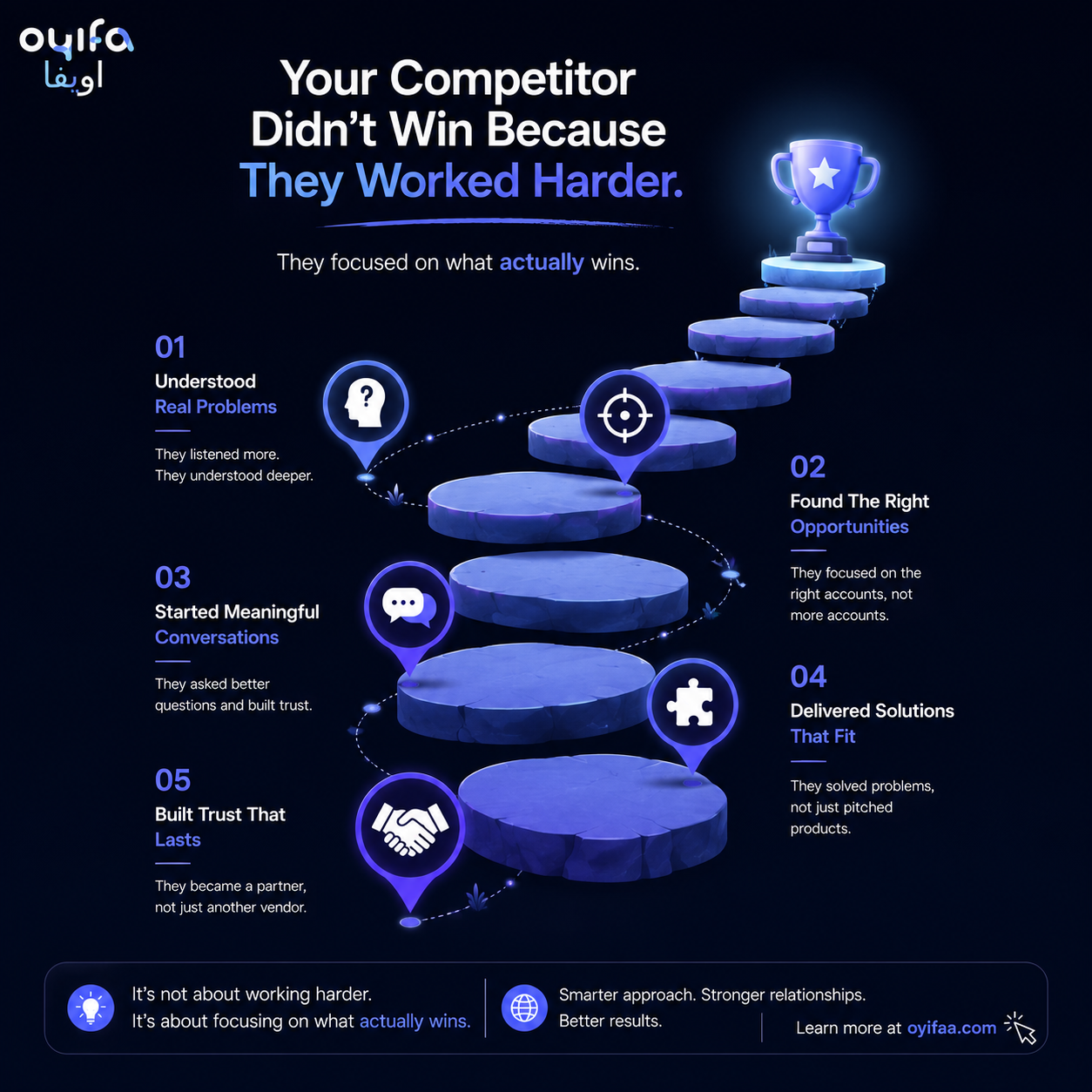
Your Competitor Didn't Win Because They Worked Harder
Every time a company loses an important deal, the immediate reaction is almost always the same. The sales team assumes the competitor had a lower price, a bigger team, or simply worked harder. It's an easy conclusion to reach because it gives us a simple explanation for a disappointing outcome.
But if you look closely at the companies that consistently win in the IT industry, you'll notice something interesting. They aren't necessarily working longer hours or making twice as many sales calls. More often than not, they're winning because they understand their customers better, ask smarter questions, and solve the right problems before anyone else even realizes they exist.
Hard work is valuable, but
hard work without direction rarely creates a competitive advantage.
🏔️ Think About Climbing a Mountain
Imagine two climbers trying to reach the top of the same mountain.
The first climber believes success depends entirely on effort. They start climbing immediately, carrying extra equipment and taking the steepest path because it looks like the quickest route. They spend more energy, become exhausted halfway through, and lose valuable time correcting mistakes.
The second climber studies the terrain first. They understand where the difficult sections are, choose a better route, and use their energy wisely. They still work hard, but every step has a purpose.
Both climbers are determined.
Only one reaches the summit first.
Business works in exactly the same way. Companies don't win simply because they work harder. They win because they know
where to invest their effort.
🎯 Customers Don't Reward Effort—They Reward Outcomes
Here's something every business leader should remember.
Customers never ask how many hours your team worked before sending a proposal. They don't care how many internal meetings you held or how many late nights your employees spent preparing presentations.
What customers actually care about is much simpler.
Can you solve their problem?
Can you reduce costs?
Can you improve efficiency?
Can you help them grow?
If the answer is yes, they'll listen. If another company demonstrates that value more clearly, they'll choose them—even if your team worked twice as hard behind the scenes.
Effort is invisible.
Results are not.
🔍 The Real Competition Happens Before the Proposal
Many organizations believe deals are won during the final presentation.
In reality, the outcome is often decided much earlier.
Long before a proposal lands in a customer's inbox, they've already started forming opinions. They've noticed which company asked thoughtful questions instead of jumping straight into a sales pitch. They've noticed who took the time to understand their business instead of delivering the same presentation they use for everyone else.
Those early conversations build trust, and trust has a huge influence on every buying decision.
By the time pricing is discussed, customers often know which company they feel most confident working with
💬 Better Questions Create Better Conversations
One of the biggest differences between average sales teams and exceptional ones is the quality of the questions they ask.
Average teams focus on explaining their products.
Exceptional teams focus on understanding the customer's business.
Instead of saying, *"Here's everything our platform can do,"* they ask, *"What's slowing your business down today?"* They want to understand the challenges, priorities, and long-term goals before suggesting any solution.
That approach completely changes the conversation. Customers stop feeling like they're being sold to and start feeling like they're speaking with someone who genuinely wants to help.
🤝 Relationships Beat Transactions Every Time
Technology can be copied.
Features can be matched.
Pricing can change overnight.
But strong customer relationships are much harder to replace.
Companies that consistently outperform their competitors understand this. They don't chase one-time transactions. Instead, they invest in becoming trusted advisors who provide value long before asking for a purchase.
Sometimes that means sharing useful insights. Sometimes it means recommending a solution that isn't even their own product because it's genuinely the right fit.
Ironically, those moments often create more trust than the best sales pitch ever could.
📈 Smart Companies Focus on These Five Things
Instead of trying to outwork everyone else, successful IT companies focus on improving the quality of every customer interaction.
✔️ They research the customer's industry before reaching out.
✔️ They identify buying signals instead of contacting every available lead.
✔️ They spend more time listening than presenting.
✔️ They connect product capabilities to real business challenges.
✔️ They measure customer success—not just sales activity.
None of these habits require working longer hours. They simply require working with greater purpose.
🌱 Winning Is About Perspective
The next time you lose a deal, resist the temptation to blame pricing or assume your competitor simply worked harder.
Instead, ask a few uncomfortable but valuable questions.
Did they understand the customer's business more deeply?
Did they build trust before discussing products?
Did they identify the customer's real priorities earlier than we did?
Did they create more value in every interaction?
Those questions lead to improvement.
Blaming effort rarely does.
✨ Final Thoughts
Success in today's IT industry isn't measured by how busy your team looks. It's measured by the value you create for customers and the confidence you build throughout the buying journey.
Your competitor probably didn't win because they stayed in the office later or made more phone calls. They won because they focused on what mattered most—understanding the customer, solving meaningful problems, and building trust before asking for the business.
When companies shift their focus from simply working harder to working smarter, conversations become stronger, relationships last longer, and winning stops feeling like luck. It becomes a repeatable strategy.
💬 Join the Conversation
What do you think makes the biggest difference in winning a competitive deal?
💡 Understanding customer challenges better
🤝 Building stronger relationships
🎯 Identifying the right opportunities
📊 Delivering measurable business value
Share your thoughts in the comments—we'd love to hear your perspective.
📖 Looking for more practical insights on B2B sales, procurement, and business growth? Explore more expert articles at *oyifa.com* and discover strategies that help you compete smarter, build trust, and win the opportunities that matter most.